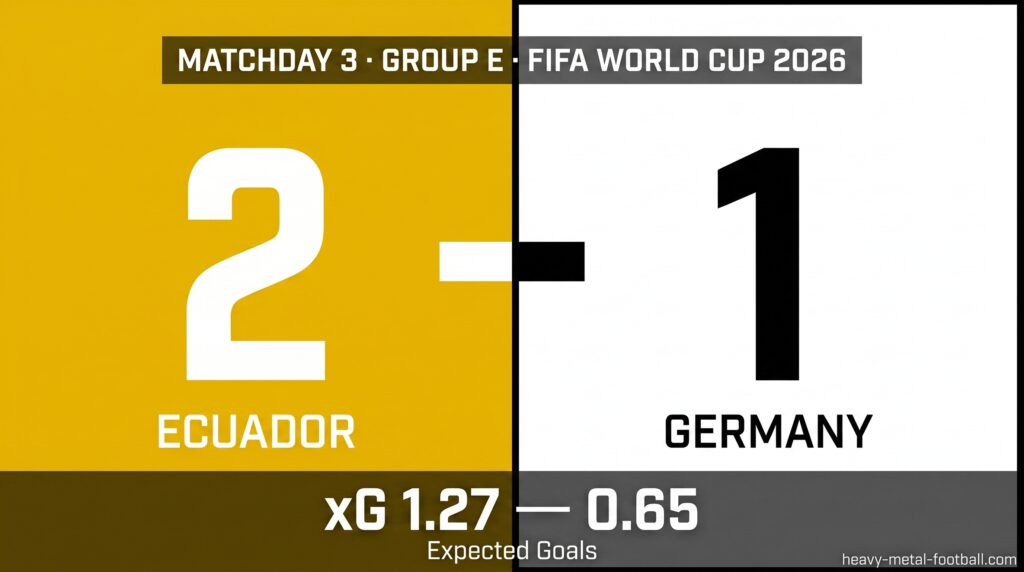
This Ecuador vs Germany analysis is part of our World Cup 2026 coverage.
Germany have a number that explains half of their night against Ecuador: in the final fifteen minutes, with the game on the line, they had the ball 76 percent of the time and did not take a single shot. Not a blocked one, not a wild one into the third tier. Nothing. That is the signature of a team that does not know how to break down a side that simply refuses to come out. But it is only half the story, because the other half had already cost them the game an hour earlier. This is a system that gives Germany everything except the two things that win football matches. It does not press, and when they have the ball, it has no safety net behind the attack. The man who was supposed to be that net for the first 45 minutes, Aleksandar Pavlovic, spent his time on the pitch proving he could not be.
Let me walk you through how a team that already topped its group, that had won eleven in a row, that controlled 61 percent of a World Cup match, walked off the MetLife pitch having lost 2-1 to Ecuador.
Start with what Germany do when they do not have the ball. They sit. Not a normal mid-block, but a genuinely passive one, a 5-4-1 that refuses to engage until the ball is about 35 meters from their own goal. No pressing trigger before that line. You can keep the ball in their half all day and nobody comes for you. The idea is to stay compact, stay organized, and dare you to play through a packed central zone. Fine. Plenty of good teams defend deep. The catch is what happens the instant Germany win the ball back.
Watch the shape flip. The 5-4-1 becomes a 3-1-6. Sometimes, when both wingbacks are fully committed, something closer to a 3-0-7: three defenders back, seven players ahead of the ball, and a single midfielder, Pavlovic, floating somewhere between the two groups with no fixed home. Picture it on a pitch. Your entire back line is three center-backs, your goalkeeper is behind them, and in front of that everyone else is already pointing at the other goal. It is a high-wire act. It works when Germany keep the ball. The moment they do not, Pavlovic has to be the entire counter-press by himself, because there is nothing behind him until you reach the back three.
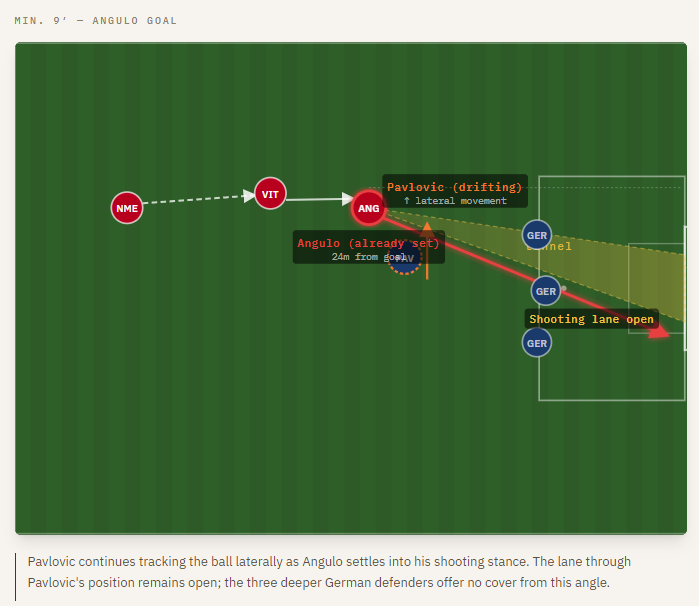
Now the ninth minute. Felix Nmecha gets the ball in midfield and gives it away under almost no pressure. Pedro Vite pounces, slides it wide to Nilson Angulo. Here is the moment the whole German system gets exposed in about two seconds. Angulo is 24 meters out. The man whose only job is to be standing right there, in front of his defenders, killing exactly this kind of transition, is Pavlovic. And he is still drifting laterally when Angulo receives it, which tells you what went wrong: he was tracking the ball moving across the pitch, not reading where Angulo would end up once it arrived. By the time he recognized the shooting position, Angulo was already set. A defender who reads that run early gets his body in front of the ball. Pavlovic was still moving when the shot left Angulo’s boot, feet not planted, and it went straight through his legs. Neuer, with the shot screened until late, goes down more than he springs. 1-1. That is a positional read failure by the one man in this system who cannot afford one.
That is the architecture of the team laid bare. A 3-1-6 with a screen who does not win his duel is a car with no brakes and a beautiful engine.
And the engine, on this night, did not run either. This is the part that should worry Nagelsmann more than one bad goal. Germany had 77 final-third entries and completed exactly two through balls all match. Two. Ecuador, with a fraction of the ball, completed seven. You could feel what that meant from the stands. Every time Musiala received the ball facing goal, an Ecuadorian body was already between him and the space he needed. He would take a touch, turn back, and recycle to a center-back. Not because he made the wrong decision, but because the right one, the forward pass, was not there. The door was not being opened. It was being held shut from the inside, and Germany kept knocking and getting the same answer.
That was the night in the middle of the pitch. Ecuador’s 5-4-1 did not defend like a flat line waiting to be pulled apart. The moment Germany’s possession went wide or went back, the Ecuadorian midfield squeezed inward and closed the return ball into the half-spaces. Wirtz and Musiala wanted to receive between the lines, in the pockets where they hurt people. Ecuador funneled them toward the touchline every time, away from goal, into the wide channels they were happy to hand over.
So Germany did what teams do when the middle is locked. They crossed. Eleven of them, into a box packed with yellow shirts who out-cleared them 30 to 15 and were never once stretched out of position. You can do that for ninety minutes. You will not score, because the delivery keeps landing on the same defensive foreheads, and all you are doing is feeding the other team’s clearance count.
Ecuador, meanwhile, were not parking a bus and praying. This is the bit that flips the lazy reading of the game. Their duel success rate, 49.1 percent, was actually higher than Germany’s 48.1. They made more tackles. They won the second ball over and over, and the instant they had it, they went forward fast: 61.6 percent of their passes were forward, a higher share than Germany managed. They had the better expected goals, 1.27 to 0.65, with a quarter of the ball. They were the team creating. Germany were the team passing.
Then the second half, and here is where the “it was basically a friendly” defense falls apart. Germany did not field an experimental side. The starting eleven was the normal one. The only two changes from the previous match, Rüdiger for the injured Schlotterbeck and Raum for Brown, were forced by injury, not choice. This was Germany’s real team, playing its real shape, level at the break against Ecuador. The experiment came later, through the substitutions, and that is its own story.
At halftime Pavlovic came off, booked and beaten, and Angelo Stiller came on. Stiller spent long stretches of the second half on the floor without being fouled, unable to live with Ecuador’s physicality. Then on the hour Nagelsmann made a triple change, taking off Kimmich and, more tellingly, Havertz and Wirtz: his most threatening player and a forward who had been winning his physical duels. He left Musiala, the weakest of his attackers on the night, on the pitch. The players who replaced them had barely featured in the tournament. The level dropped, and you could see it.
The winner, when it came in the 77th minute, came from the one place a high-possession team with a deep, tired block is most fragile: a set piece, with a runner nobody tracked. Corner in. David Raum loses the near-post header. Kevin Rodriguez flicks it on. Now look at the box. Neuer, 40 years old, decides to come and punch, sets off too slowly, arrives nowhere. And in front of him, Tah is watching the ball the whole way, eyes up on the flight and then on the keeper coming out, never once checking his own shoulder. Behind his back, Gonzalo Plata has quietly stepped off him into the space at the back post. By the time the ball drops, Tah is marking grass and Plata is marking the goal. He sticks his foot out in front of the static keeper and finishes. Germany got punished by the oldest set-piece move there is: the blind-side run on a defender whose eyes never left the ball. Same lack of cover, different phase of play.
Then the final fifteen minutes, and that number again. 76 percent of the ball, zero shots. A team in complete control of the territory and incapable of doing anything with it. That is not nerves. That is a system that, against a side willing to sit and run and refuse to be impressed, has no idea how to find the goal.
So here is the question everyone wants answered. Was this the real Germany, or a dead rubber where nothing should be read into it? The honest answer is that the friendly framing lets everyone off too easily. The starting eleven was the real one. The shape was the real one. The problems were the real ones: Pavlovic as a lone screen in a reckless attacking shape, no pressing plan, Kimmich miscast in a role he does not play for his club, no way to break a committed low block. All of that was true against Ivory Coast too. The win streak just kept it offstage. Ecuador, by refusing to blink, dragged it into the light. The rotation did not create these problems. It pulled away the quality that had been hiding them.
And the timing could not be worse, because the Round of 32 starts Monday. Germany have only a few days. The two things that beat them on Thursday, the brittle single pivot in transition and the inability to unlock a packed defense, are not exotic problems that only Ecuador could find. They are the first two things any halfway-organized knockout opponent will go looking for from the opening whistle. Germany have a handful of training sessions to find an answer. On the evidence of New Jersey, they do not have one yet.