This Scotland vs Brazil tactical analysis is part of our World Cup 2026 coverage.
Scotland flew to Miami to play for a draw. That was the honest version of the plan. Build a deep block, frustrate Brazil, take whatever point the math required. It was rational. A draw almost certainly sends them through as one of the eight best third-place teams, the exact lifeline the 48-team World Cup was built to provide. Steve Clarke had read the situation correctly. The problem was that the game didn’t wait for his shape to set.
Seven minutes in, Scott McKenna took a short pass from Angus Gunn in front of Scotland’s defensive third. His hips were already half-turned toward his own goal when the ball arrived. He took too long. Rayan, the 19-year-old who replaced the injured Raphinha read the hesitation and got a toe to it. Vinícius Júnior was already moving. By the time Gunn came off his line, the angle was gone. Vinícius rolled it into an empty net and jogged back to the center circle.
That was the whole match in seven minutes. Everything after was Scotland trying to run a game plan that no longer made sense, and Brazil making sure they never had to work for the win the way a goalless hour might have forced them to.
What the Block Was Supposed to Do
Here is Clarke’s system when it functions. Five defenders across the back. Wing-backs Robertson and Patterson sitting narrow enough to deny the central channel. Four midfielders compressing the space between the lines. Shankland alone up front as a reference point for the rare counter. Brazil would have the ball. Scotland would absorb it.
A 5-4-1 against a quality side isn’t passive. It’s a bet that the other team eventually makes the mistake, an overhit pass or a loose pivot, something you steal and turn into a counter. And if you have set-piece quality, the way Scotland do with McGinn and Ferguson over dead balls, you build a second threat off corners.
Two things broke the plan before it could breathe. The first was the McKenna error in minute 7. You cannot run a containment game from behind, and Scotland were behind inside seven minutes. The second was losing Robertson to injury at half-time, which forced Tierney on cold and reshuffled a left side built to stay compact. Neither of these is the block failing on its own terms. They are the block never getting tested the way it was drawn up.
And the one weapon that might have stolen something back never fired. Scotland’s deep block was always going to cede possession. The bet was that their set-piece delivery, bodies attacking the box off McGinn and Ferguson service, would manufacture the goal open play couldn’t. That bet died in the air. Brazil won 73.7% of the aerial duels to Scotland’s 26.3%. When you lose the air that completely, your corners are just possession you hand back. Scotland won seven of them and threatened from none.
The Second Goal Was the Real Crime
The first goal was a mistake. The second was a sentence.
Minute 45+3. Scotland had actually settled after the first-half water break. They won a few corners, got some touches in Brazil’s third. They were down one, not out. And then Brazil pressed the clearance, won the ball back on the edge of the box, and Bruno Guimarães clipped a precise cross to the far post.
Here is why it ended in the net and not in the keeper’s gloves. The ball was hung toward the back post with enough pace and accuracy to drop behind the front defenders but in front of goal, the exact zone where a keeper has a fraction of a second to decide whether to claim it or hold his line. Gunn came. And he misjudged it completely, sailing out underneath the flight so the ball cleared his reach and dropped beyond him. The instant he committed, he had emptied his own goal. Vinícius Júnior had peeled to the far post behind the last Scottish shoulder, and with the keeper stranded in the middle he headed into a net nobody was guarding. A pinpoint cross and a goalkeeper who went for a ball he was never reaching. 2-0.
That was half-time, and Scotland’s chance to stay in their shape went with it. You’re not playing for a draw when you’re two down to Brazil. You’re playing for something that probably isn’t coming.
The Physical Battle Scotland Couldn’t Win
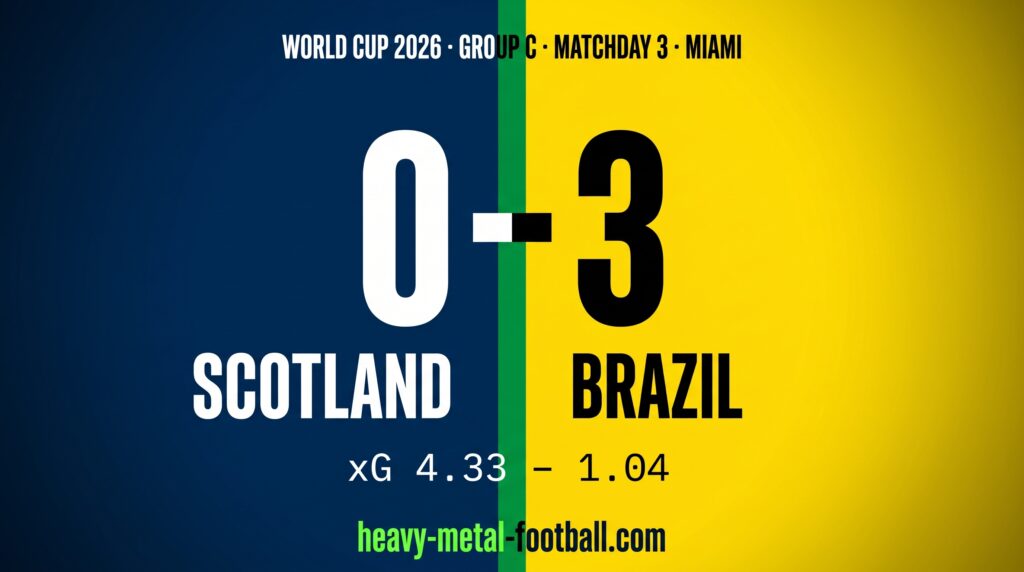
The second half was less about tactics than about a quality gap Scotland couldn’t paper over. The summary number is the expected-goals total: Brazil 4.33, Scotland 1.04 by kicker’s count, one of the widest margins of the tournament. Underneath it, the duels. Brazil won 62.8% of them to Scotland’s 36.3%. Eleven successful dribbles to two. These aren’t numbers about fitness or desire. They are what happens when technically superior players meet a team set up to defend rather than press.
The third goal made it official. Minute 60. Casemiro feeds Bruno Guimarães in the right half-space, maybe twenty-five yards out, and Kenny McLean steps across to press him. Watch what Bruno does with his body. He doesn’t try to turn away or knock it past him. He plants his left shoulder and backside into McLean’s run, shields the ball, and slows everything to a stop. McLean is now leaning on Bruno’s back, committed and out of the play. In that pause Cunha, arriving from deeper and central, runs off the back of his marker into the channel Bruno has just frozen open. Bruno rolls it into his path. Cunha takes one touch to steady and finishes low into the bottom corner past Gunn. The goal was won in the body contest. Bruno didn’t just keep the ball, he used McLean’s own momentum to remove him from the picture and time Cunha’s late run into a lane that didn’t exist two seconds earlier.
The recovery map tells the same story. Scotland made 23 of their ball recoveries in their own defensive third, which sounds busy until you realize a defensive-third recovery means the ball was already deep in your area when you won it. The number that matters is the middle. Brazil recovered the ball 19 times in midfield, Scotland just 6. Picture one of those. A loose ball bounces near the center circle, a Scotland player gets a foot to it, and before he can lift his head Casemiro or Bruno Guimarães is on his shoulder, nicking it back and driving upfield. Nineteen to six. When you lose the midfield by that margin you don’t get to build anything. You defend, you clear, and you wait for a set piece that, as we’ve seen, wasn’t coming either.
The History Scotland Kept Missing
There is something bleak about Scotland’s attacking output across this tournament. One goal. Against Haiti. Minute 31. A header. McTominay’s effort in the 49th minute against Brazil was their first shot on target in 200 minutes of World Cup football. More than two full games.
A nation went 25 years to get back to this stage. Their support turned Hard Rock Stadium into something close to Hampden for 90 minutes. The football in return has been three games of organized caution and one goal. To be fair, the plan had logic. Scotland beat Haiti, drew a tactical fight with Morocco, and sit on three points needing other results to break their way. If they go through, it’s as a team with one goal and minus-three goal difference reaching a World Cup knockout round. Whether that reads as the 48-team format doing its job or as something the format got wrong depends on what you think these competitions are for.
The Neymar Footnote
Neymar came on in the 76th minute and the noise told you what he means here. More than two years and eight months since his last Seleção appearance, and the crowd chanted his name from the bench before Ancelotti gave him the nod. He had 14 minutes, one shot Gunn held, one free kick that was cleared. He didn’t change the game and wasn’t asked to. He was being eased toward something. Whether a 34-year-old back from a long absence can still do it at knockout pace is an open question. Tonight gave Ancelotti a safe quarter-hour at 3-0 to begin answering it. The real answer comes later.
Seven Minutes, Revisited
Brazil go to the Round of 32 as Group C winners, off to face the Group F runner-up. Scotland wait by the phone. If they go through, they’ll meet a side good enough to have topped its group, which, on the evidence of this one, doesn’t look like a road to the quarterfinals.
The McKenna backpass in minute 7 wasn’t just a mistake. It was the game. Before the deep block could function, before the set pieces could be tested, before Robertson could settle the left side, Scotland handed Brazil exactly the kind of goal the whole system existed to make them earn. From the moment that ball rolled into an empty net, the plan was a museum piece.
Seven minutes. That’s all it took Brazil to make this easy.