URUGUAY VS CAPE VERDE WORLD CUP 2026: How the 2-2 Happened
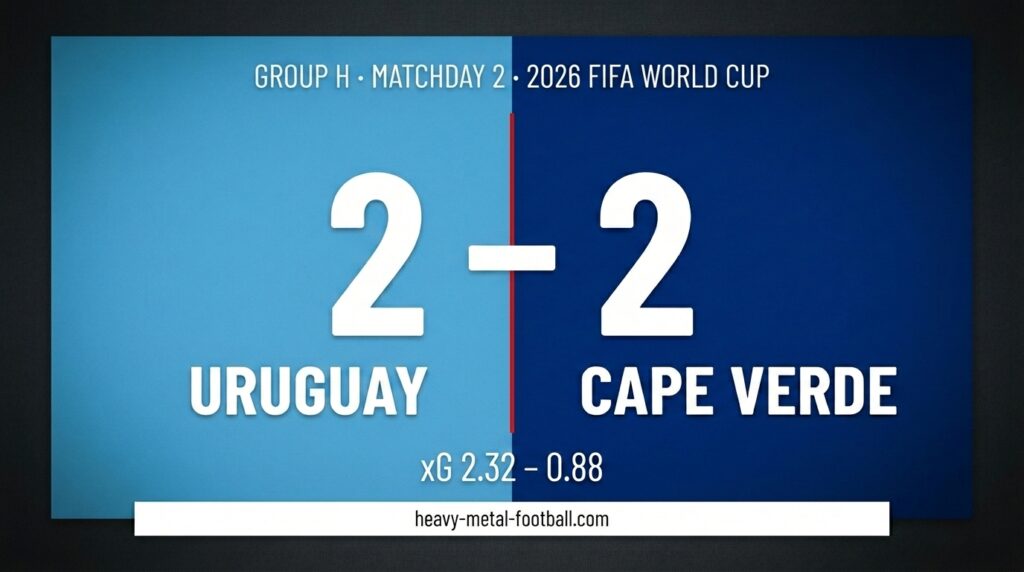
Uruguay walked into Cape Verde’s penalty area fifty-one times in their 2026 World Cup group game in Miami. Fifty-one. That’s not a typo. It’s the Opta number, sitting there next to Cape Verde’s fifteen. Uruguay spent the whole night living in the other team’s box, knocking on the door over and over, and they walked away with two goals: one that came off a Cape Verde defender’s own skull, and one tapped in from five meters after a header bounced loose in the chaos.
That’s the whole match in a sentence. A two-time World Cup winner had the ball, the territory, the corners, the crosses, the expected goals — 2.32 of them to Cape Verde’s 0.88 — and a nation of half a million people that had never played at a World Cup before this month walked off the Hard Rock Stadium pitch with a point they earned every inch of.
So how does that happen? Not by accident. Let me show you the geometry of the Uruguay vs Cape Verde World Cup 2026 match.
The Wall That Wasn’t There
Start with the first goal, because it tells you about Uruguay before it tells you about Cape Verde. Minute 21. Telmo Arcanjo carries the ball straight through the middle of the park, gets clipped by Bentancur — who was already on a yellow, remember that — and Cape Verde have a free kick thirty meters out. Long range. The kind of distance where most teams roll it sideways and recycle.
Kevin Pina, a defender, stands over it and decides he’s shooting.
Now watch Uruguay’s wall. They build a two-man wall, Araujo and Vinas, and the two of them open up. Not a small gap. A door. Pina sees the whole right side of Muslera’s goal through the space where two bodies should have been touching shoulder to shoulder, and he drills it flat and low into the corner.
Muslera throws himself full-stretch and gets nowhere near it. The keeper isn’t blameless, but the goal starts with two men in a wall who didn’t close the space between them. Thirty meters out, and Cape Verde score because Uruguay left the curtain open.
That’s the underdog’s entire night in one set piece: do almost nothing for long stretches, then punish the one moment the favorite stops paying attention to the small stuff.
Why the Ball Went Everywhere and Nowhere
Here’s the thing that should worry Bielsa more than the free kick. Cape Verde barely tried to play football for ninety minutes. They tried to defend for most of it, and they were ruthlessly good at it: the kind of organized, disciplined wall that turns a possession team’s evening into a slow headache.
Against that, Uruguay set up in a 4-2-2-2, and the shape did them no favors. Two strikers up top, two creators behind them, two holding midfielders, and width coming almost entirely from the fullbacks. The problem with that against a deep block is simple: everything funnels into the middle, which is exactly where Cape Verde wanted you.
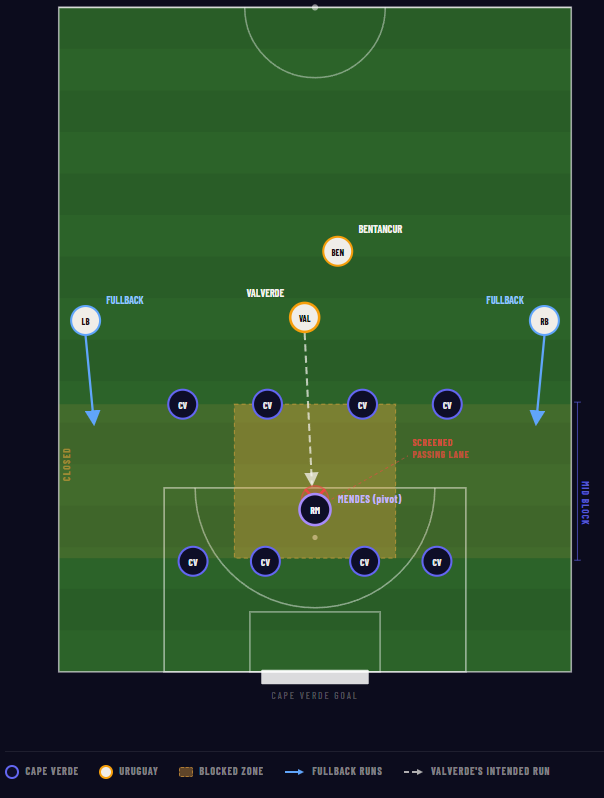
Cape Verde’s 4-1-4-1 didn’t stay a 4-1-4-1 once they lost the ball. It compressed into something closer to a 4-5-1 mid-block, with the four midfielders dropping narrow and Ryan Mendes, the single pivot, sitting right in front of the defensive line and screening the exact corridor where Valverde wanted to receive. When Uruguay’s fullbacks pushed wide and the ball moved out toward the touchline, Cape Verde’s midfielders didn’t track them. They stayed central, kept the shape, let Uruguay have the wide zones, and waited. Crossing into a nine-man block from the angle of a fullback overlap is almost never the right answer. But that was Uruguay’s answer, twenty-nine times.
The 93.8% tackle success rate tells you what the block felt like on the ground: sixteen challenges, fifteen won. Cape Verde’s defenders weren’t lunging in from distance. They were reading the first touch. A Uruguayan receives, the ball sticks slightly, he takes a half-second too long to settle it, and a Cape Verde man is already through the line and onto the ball before he can turn. Sidny and Canobbio ran this contest down the left channel all night: Sidny giving ground, staying goal-side, then timing the hit the moment Canobbio’s weight tipped forward. Canobbio won free kicks. He almost never won the yard.
When the central route closes, you go wide and cross. Uruguay crossed twenty-nine times and completed four of them. Imagine throwing twenty-nine darts at a board and hitting the wire twenty-five times. That’s what Uruguay’s delivery looked like for most of the night. You can do that all evening, but if the ball keeps landing on defenders’ heads and clearing the box, you’re not creating pressure. You’re just running a shuttle service for Cape Verde’s clearance count, which finished at forty-eight.
The picture you want is minute 40. Canobbio swings one to the back post and Maxi Araujo is standing there completely alone, nobody within five yards of him, the kind of free header you’d take in training without thinking. And he puts it over the bar. The space was there. Uruguay found it. The execution wasn’t.
The Four Minutes Where It Worked
And then, right before half-time, Uruguay scored twice in roughly ninety seconds of game time, and neither goal came from breaking the block down. Both came from chaos.
The equalizer at 44: Valverde clips a cross in from the half-space, and Sidny, trying to clear it, heads the ball onto his own inner post. It rebounds out, and Araujo is right there to nod it over the line from close range. An own-goal deflection that fell to the right man.
The second at 45+6 is cleaner than it looks. Ugarte arrives in the right half-space with enough time to actually stand over the ball and pick his delivery. That almost hadn’t happened all first half. Cape Verde’s block had been forcing Uruguay’s wide players to cross early and under pressure, which is why twenty-nine crosses produced four completions.
This time Ugarte is on the ball with nobody closing him down, because Vinas has dragged his marker, Moreira, across the face of the six-yard box with a run toward the near post. That pull opens a two-yard gap at the back post that didn’t exist a second earlier. Araujo attacks it, flicks a header across the face of goal, and the ball drops to Canobbio five meters out. He doesn’t have to do anything except keep his foot flat. 2-1.
Look at what those goals actually are. Not patient combination play picking a lock. Not a clever rotation that pulled a defender out of position. They’re crosses thrown into a crowded box at speed, bouncing off bodies, falling loose, and a Uruguayan reacting first. That’s a legitimate way to score — fill the box, create noise, gamble that the second ball drops kindly — and over 51 entries it’s going to work sometimes. But it’s not control. It’s pressure plus luck, and luck doesn’t sign a contract to show up after the break.
The Pass That Decided It
Which brings us to the moment this match will be remembered for. Minute 58: Olivera grabs a fistful of Benchimol’s shirt as the striker tries to break toward goal, and gets booked. He’s now on a yellow, walking the tightrope, and everyone in the stadium knows it.
Three minutes later, the ball comes to him on the left side of his own penalty area. No one is pressing him from behind. His body is open, he has time, he has options: play it forward, play it out to the line, hammer it into the stands if you have to. Instead he passes it square. Straight across the front of his own goal. Into the feet of Helio Varela, who had been on the pitch for exactly three minutes.
Varela takes one touch to set himself, and he doesn’t hesitate for a heartbeat, because he’d clearly come on knowing exactly what he’d do if a ball like this ever arrived. Muslera rushes out to close the angle and only manages to take away the near post, leaving the far side of the goal open. Varela finds it. From the moment Olivera’s pass left his foot to the ball hitting the net was under two seconds. 2-2.
You can’t draw that on a tactics board. There’s no system that produces it and no system that fully prevents it. It’s a player whose brain switched off for one second against an opponent whose brain was switched all the way on. The substitute came on hunting for that exact mistake, and he got it.
This Is the Bielsa Story, Whether We Like It or Not
If this felt familiar, that’s because it is. Bielsa teams have a shape to them across a whole career, and it isn’t the shape of the pitch — it’s the shape of the arc. Explosive at the start, admired by everyone, and then a slow erosion as opponents work out that you’ll always give them the ball and always come at them the same way.
The warning signs were all there before Miami. Uruguay went into the 2024 Copa América as the top scorers in South American qualifying. The Bielsa system was humming: they beat Brazil at home and Argentina in Buenos Aires. Then the wheels came off during that tournament, and they never quite went back on.
No goals in eight of their final twelve qualifying rounds. A 5-1 friendly hammering by Pochettino’s USA in November, where Bielsa sat in the stands and watched his own ideas executed better by a man he’d mentored. The system stopped generating chances, and nobody had a convincing explanation for why.
Against Cape Verde you saw that same ceiling. A team built to dominate, dominating, and finding that territory doesn’t come with goals attached. Bielsa has said this job ends with the World Cup in July. He is not going to change the shape for Spain. Uruguay will line up the same way they did against Cape Verde and Saudi Arabia before them, and whether that reads as principled or stubborn depends entirely on what the scoreboard says when the final whistle goes.
The image that sticks isn’t Olivera’s pass, though. It’s Valverde in stoppage time, the best player on the pitch, standing in a central position with the ball sitting up for him and the game level. Five shots on the night, his most ever in a World Cup match. And he leans back and puts this one half a meter over the bar too. All that talent, all that running, all that responsibility taken on — and the final touch just isn’t there.
Fifty-one doors. Nobody home. Cape Verde took their point and went home happy, and they were right to.