Norway vs Senegal World Cup 2026
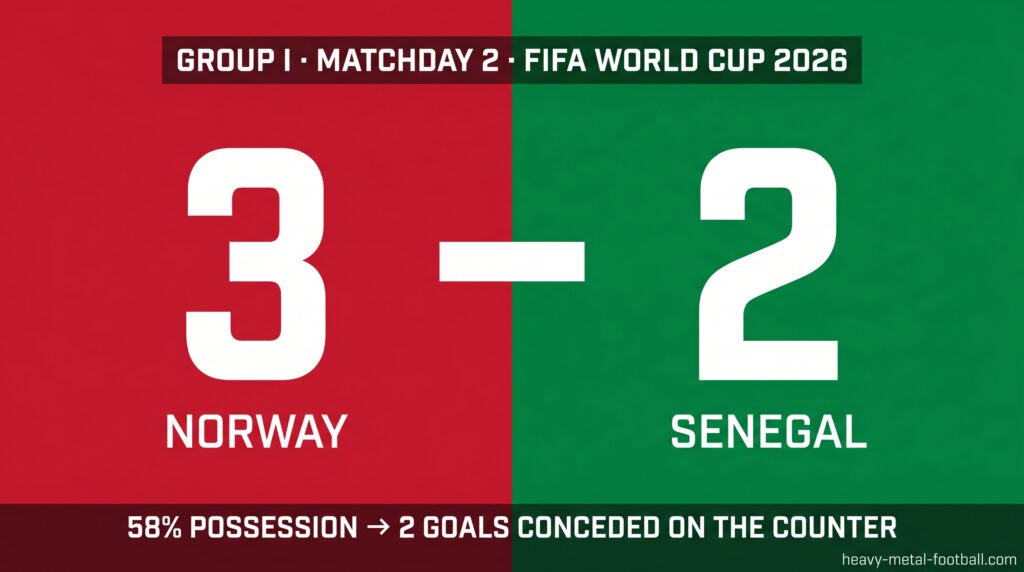
Senegal had fifty-eight percent of the ball. They completed 447 passes. They entered the final third sixty-four times. And by the 58th minute, they were 3-1 down and watching Erling Haaland celebrate in front of 80,000 people in New Jersey.
That sentence should not make sense. Possession is supposed to mean control. Control is supposed to mean safety. But Norway spent the whole night proving a simple, brutal idea: you can hand a team the ball, fold your arms, and still take their lungs out, as long as you’ve built the trap correctly and you have the right man waiting at the end of it.
This is the story of how they built it.
Built to Absorb
Start with the shape, because everything flows from the shape. Solbakken set Norway up in a back five that dropped into a flat bank of five defenders and four midfielders the moment they lost the ball. A 5-4-1. One striker up top, and that striker was Haaland, standing almost completely alone.
If you looked at Norway’s pass map afterward, you’d see something strange. Haaland barely appears in it. The thick lines, the heaviest passing connections, the ones that show where the ball actually lived, all cluster deep in Norway’s own half. Players standing tight together, ten or fifteen yards apart at most, recycling the ball in safe areas with no ambition to build toward goal. A dense purple knot pulled back toward their own goalkeeper. And then, way out on the edge of the picture, almost disconnected from the rest of the team, the number nine. One man, alone, in acres of space he hadn’t touched yet.
That isolation was the plan. Haaland was not there to help build anything. He was a loaded spring. Norway would soak up Senegal’s possession, win the ball, and release a man who had spent the entire night doing something most forwards hate doing: nothing.
Haaland’s positioning in the lulls between attacks wasn’t passive. He was working Koulibaly constantly, leaning into his shoulder, nudging his starting position half a yard deeper with every exchange, making the center-back think about him even when the ball was on the other side of the pitch. The moment Norway won possession, that groundwork paid off. Koulibaly was already half-turned, already slightly deeper than he wanted to be, and Haaland was already accelerating before the pass arrived.
Senegal, meanwhile, did what Senegal do. Pape Thiaw’s 4-3-3 wants width and volume. Push both full-backs high, work the ball through Idrissa Gueye and the midfield, swing crosses in from the touchlines and feed Mané and Sarr in the wide channels. It’s a good system. It beats teams that come out to meet you, because the moment you press it, it stretches you and plays through the gaps.
Norway didn’t press it. Norway just stood there. Five defenders, refusing to be stretched, refusing to come out. So Senegal kept the ball and kept crossing, 23 crosses on the night, almost all of them meeting a Norwegian forehead or a Norwegian boot. The block didn’t bend. It absorbed.
Here’s the thing nobody tells you about absorbing pressure: it’s only worth doing if you can hurt the team on the way back out. That’s where the whole match turned.
Four Against Two
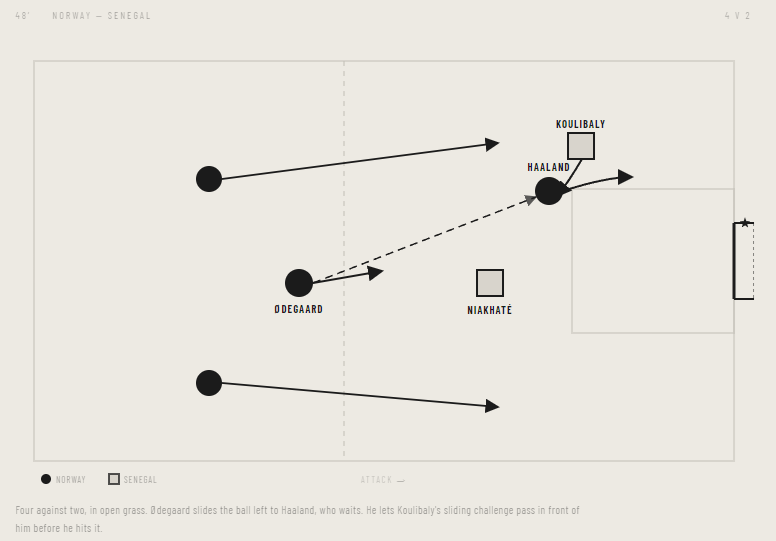
Watch the second goal. The 48th minute, three minutes after halftime.
Senegal are attacking. They’re in Norway’s half, comfortable, probing for an opening. And then a pass goes loose, and Ødegaard is on it.
Look at his hips. This is the detail that decides the goal. The instant the ball arrives at his feet, Ødegaard’s body is already turned upfield. He doesn’t take a touch to settle, doesn’t check his shoulder, doesn’t slow down to assess. He has spent three years at Arsenal training his body to do exactly one thing in this exact moment: face forward and go.
He drives. And as he drives, Norway pour forward around him, runners bombing on both sides, while Senegal’s two center-backs are caught flat-footed and facing the wrong way. They were in an attacking posture a second ago. Now they’re the last line, and there are four black shirts running at them.
Four against two, in open grass. Ødegaard slides the ball left to Haaland, who waits. This patience is the masterstroke. He lets Koulibaly’s sliding challenge pass in front of him before he hits it. First time. Top corner. Mendy has no chance.
That’s the trap in its purest form. Senegal’s strength, their possession, became the exact thing that killed them, because possession high up the pitch means your defenders are high up the pitch, and Norway had a man whose entire night was built around the space behind them.
Same Trap, Different Trigger
The third goal, ten minutes later, is the same trap with a different trigger.
This time it’s Koulibaly trying to control a ball inside his own box. His weight is on his front foot, leaning forward, committed to playing out the way his system demands. When the ball arrives slightly awkward, there’s no way to adjust. A player with their weight forward can’t shift their center of gravity fast enough to correct a bobbling touch; the ball skips away before the brain can send the message to the feet. Berg is already moving as it happens. Two quick steps to open the angle, a clipped cross from the left, and Haaland arrives at full pace to volley it off the underside of the bar and in. With his right foot, his weaker foot. It almost feels rude.
Both goals come from a center-back caught carrying the ball in a dangerous area. That’s not bad luck. That’s a system meeting its opposite. Thiaw’s Senegal asks its defenders to be ball-players, to drive forward and play through pressure. Solbakken’s Norway was built, brick by brick, to punish exactly that.
The numbers underneath are almost cartoonish. Norway won 90% of their tackles. Senegal won 43.8% of theirs. When Norway decided to take the ball, they took it cleanly, and they were gone before Senegal could blink.
None of this means Senegal were bad. This is the part the scoreline hides.
And the part it hides most is Sadio Mané. At 34, playing his club football in Saudi Arabia, there were genuine questions coming into this tournament about whether he still had the sharpness to hurt teams at this level. Tonight gave an answer, even in defeat. He didn’t score, but he was the architect of everything good Senegal did going forward: dropping into half-spaces to receive, turning defenders with one touch, reading counter-movements before they happened. Both of Sarr’s goals have his fingerprints on them.
Twice, Senegal showed exactly how to break a deep block, and both times Mané unlocked it and Sarr finished it.
The 53rd minute: Gueye slides a flat ball to the edge of the box, and here’s where Senegal finally found the combination Norway’s block couldn’t handle. Mané, who had spent most of the night tucked into the left half-space rather than hugging the touchline, meets the ball with a single redirecting touch. Not to shoot, not to carry, but to slide it into the channel opening up behind Wolfe. The left wing-back was caught between two jobs: hold his defensive position or step to Mané. He hesitated for half a second, and that half-second was all Sarr needed. He hit the gap at full sprint, got in behind, and finished at full stretch into the roof of the net.
That’s not a mistake by one player. That’s three Norwegian defenders caught in the same instant of indecision, because Senegal moved the ball faster than the block could reorganize.
The second one came in stoppage time. Ajer misses a clearing header, Jackson cushions it down, and Sarr arrives with proper momentum to lash it home. The buildup ran through Mané again, drawing two Norwegian defenders before the ball broke loose.
Sarr now has three World Cup goals, matching Papa Bouba Diop, the man whose goal against France in 2002 announced Senegal to the world. He’s the first Senegalese player to score across two different tournaments. On a night his captain fell apart, Mané created and Sarr delivered. That combination, given more time and a different scoreline to chase, is a real threat for any team they face next.
The Plan They Believed In
There’s one more thing worth sitting with, because it nearly broke Norway’s plan before it started.
In the 13th minute, Julian Ryerson went down holding his thigh. Ryerson is Norway’s best attacking full-back, an assist machine, exactly the kind of overlapping crosser who hurts teams from wide areas. Losing him that early should have been a problem. Solbakken had to throw Marcus Pedersen on cold, into a right-back slot that Mané and Diouf were already circling.
And then Pedersen scored. The 43rd minute, his first goal for his country, gifted to him by Koulibaly, who inexplicably passed the ball straight into his path outside the box. Pedersen drove in and tucked it past Mendy at the near post. The position that was supposed to be Norway’s wound became the source of their lead.
That’s the difference between a team that has a plan and a team that believes in it. Norway lost their most dangerous wide player inside fifteen minutes and didn’t change a thing. Same shape. Same patience. Same trap. They understood they were winning the territory war even at 0-0, even down a key man, and they trusted it to pay.
So Norway are through to the knockout stage of a World Cup for the first time since 1998. Twenty-eight years. When they last did this, Haaland hadn’t been born yet.
They got here by being willing to look worse than they were. By giving up the ball, the territory, the passing stats, all the pretty numbers, and keeping the only one that matters. Three goals from a striker they kept on a leash all night, then let off it the moment Senegal left a door open.
Senegal had fifty-eight percent of the ball. Norway had Erling Haaland. It wasn’t close.