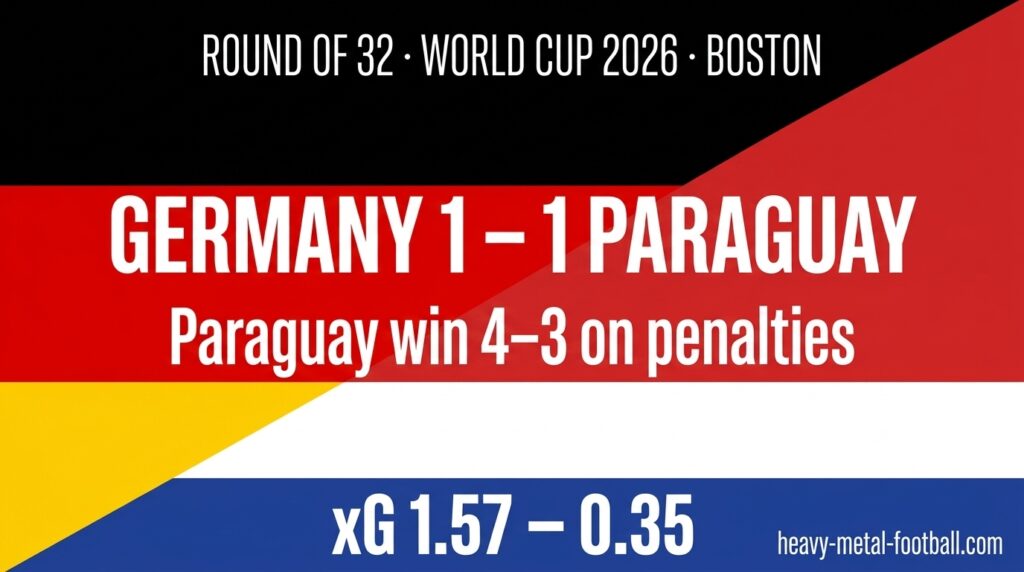
Germany Paraguay tactical analysis | 1-1 AET, Paraguay win 4-3 on penalties | FIFA World Cup 2026, Round of 32
This is part of our World Cup 2026 coverage.
Germany’s expected goals in the first half against Paraguay: 0.15. Not for want of the ball. They had nearly 79 percent of it before the break, moved it at 90 percent accuracy, and lived inside Paraguay’s half. Zero point one five is what all of that was worth in front of goal. By the time the night was over, 120 minutes and 805 passes later, Germany had built 1.57 xG and Paraguay had 0.35. Paraguay won.
They won 4-3 on penalties, after 1-1 in extra time, and they carried out of Boston something that had never left the building before. Germany had never lost a World Cup penalty shootout. Four from four, 17 of 18 kicks, a record that read like a law of physics. A Paraguay defender named José Canale repealed it. This is the story of how a team completes more passes than anyone left in the tournament, out-shoots its opponent 21 to 7, and still goes home. The Germany Paraguay tactical analysis underneath it comes down to one gap: possession is not penetration, and composure is not conviction.
The overlap that never came
Paraguay lined up 4-3-3 on paper, Andrés Cubas alone at the front, Julio Enciso and Miguel Almirón as the wide forwards. Out of possession that shape folded backward into something far more crowded: the wide forwards dropped level with the midfield, Cubas screened the space in front of the back four, and Germany met a wall five and sometimes six men across. Tactics correspondent Umir Irfan named the mechanism live in the 36th minute. Paraguay funneled Germany toward the touchline, and the touchline only pays if the winger standing on it can beat his man one against one.
Germany’s answer was to not use the touchline at all. Watch minute 40. Joshua Kimmich, the nominal right-back, is standing inside in a central-midfield body shape rather than sprinting the outside lane. He does it again. And again. By the 83rd minute Julian Nagelsmann stopped pretending and moved Kimmich formally into central midfield behind a back three, an admission that his right-back had never been playing as one.
The scoreboard of it sits in the crossing column. Germany swung in 55 crosses and completed 16.4 percent, a worse rate than Paraguay managed from a third of the volume. They also beat more men on the dribble than Paraguay did, 15 to 8, and not one of those dribbles came inside the box or in a genuinely dangerous area. Touches without a way through. José Canale spent the night throwing his body in front of things, twice inside five seconds in the 56th minute alone. Cross 55 times into a packed area and that is the defending you invite.
A pointed finger, a mark nobody took
Germany’s back line had, until the 42nd minute, done almost nothing. Paraguay had not attempted a single shot in the half-hour before they scored. So the goal did not come from pressure. It came from a conversation between two defenders that never finished.
Paraguay won a corner, Neuer punched it away, and the ball was worked back out to the flank: a clearance, a pass square, and suddenly a 2v2. Nathaniel Brown and Aleksandar Pavlović stand against the man on the ball and Matías Galarza, who is already peeling into the run behind them. Watch Brown’s hand. He points inside, the universal signal for “I have the runner, you take the ball,” and then he does not let go of the ball carrier. Pavlović does not let go either. Two Germany defenders lock onto one Paraguay player three yards apart, and Galarza runs off the back of both of them, untouched, to the byline. His cross finds Julio Enciso with not a white shirt within five yards. Header, goal.
By halftime Germany had turned nearly 79 percent of the ball into 0.15 xG, and Paraguay had turned one recycled corner into the lead. All that territory, one clean chance conceded. Paraguay’s whole first half reduced to one pointed finger and one mark nobody took.
The Germany Paraguay tactical analysis in three numbers
Three expected-goals snapshots tell the night. 0.15 by halftime: a half of possession worth about a sixth of a goal. 0.79 at the end of 90: a full regulation match of the ball, 14 shots, and still under one clear chance’s worth of danger. 1.57 at the final whistle of extra time, from 21 shots. Do the division and every Germany shot was worth about 0.075 xG, the signature of a team firing from distance and from crowds rather than from space.
Now hold Paraguay’s number beside it: 0.35, and it stopped moving after regulation. They did not register a single shot in the whole 30 minutes of extra time. Their last attempt of the match came in the 93rd minute. For the final half-hour Paraguay’s attacking output was zero and their defending was everything, and it was still enough, because Germany’s 1.57 arrived in the wrong shape. Half of it, 0.78, was manufactured only in extra time, once the game had already gone to the place Paraguay wanted it.
Why Germany lost to Paraguay: the chance to close it out
There was a window, and Germany walked past it. Julio Enciso, the one Paraguay player who could turn a clearance into a counter, limped off injured in the 57th minute. Without Enciso lost their only outlet. For the next 33 minutes Paraguay were defending a lead with no way to hurt anyone, legs going, no release valve.
That is the moment to turn the screw. Germany did not. Their possession share sat between 71 and 84 percent in every 15-minute block for the rest of normal time, the same width-less shape, the same crossing, the same low-value shooting. On the pitch it looked like a team passing in front of a parked bus and waiting for the bus to tip over on its own. Kai Havertz’s 54th-minute equaliser, headed in off a Florian Wirtz cross from the left, had already shown the one route that worked: get wide, whip it in early, attack the near post. Germany kept choosing everything else.
Their competence, when it came, came late. Jonathan Tah headed in a Nathaniel Brown corner in the 102nd minute, ruled out by VAR for a block on Gill. Extra time is also where Germany finally started winning the fights they had lost all night. After 90 minutes of losing more duels than they won, they took 54 percent of them in extra time and 65 percent of the aerials. The 0.78 xG they built in that half-hour beat their first 90 minutes combined. The right performance at the wrong hour. It showed up only once a single mistake would end the tournament, and by then Germany could not force Paraguay into one.
The ice that cracked
Some records are so old they stop feeling like records and start feeling like traits. Germany do not lose World Cup shootouts. Four of them, four wins, 17 goals from 18 kicks across decades. The walk to the spot was supposed to be where German conviction showed up no matter how the previous two hours had gone. This was their first shootout loss at a World Cup, and only their second at any major tournament since the European final of 1976.
Orlando Gill started the unravelling. He made Kai Havertz wait, ball in his hands, an age at the spot, and when Havertz finally struck it the kick was low and close to the keeper, saved. Nick Woltemade’s was tamer still, pushed away to Gill’s left. Then Jonathan Tah, Germany’s best player across extra time, put the last one so far over the bar it was, by one reporter’s account, still travelling. Three penalties, no conviction in any of them, from the country that had built a myth on precisely that quality.
Paraguay were not flawless from twelve yards either. Antonio Sanabria dragged one wide and Neuer saved Fabián Balbuena. But Mauricio, Gustavo Gómez and Matías Galarza never flinched, and José Canale, who had just defended for 120 minutes, finished last into the corner Neuer could not reach. Havertz said it plainly afterward: “I don’t think we deserved to win this time.” The absence that ran through the whole match, all that composure on the ball and none of it in front of goal, followed Germany the length of the pitch to the penalty spot and took the one thing they were sure they owned.
The Paraguay side that refused to blink
None of this happens without a discipline that borders on monastic. Paraguay had the ball 24.4 percent of the time and completed 255 passes to Germany’s 805, reportedly the lowest possession share of any side in the round of 32. They cleared it 55 times to Germany’s 23 and won 33 tackles to Germany’s 13, and they still ended the night holding the single cleanest chance in it.
Cubas set the physical terms from the base of midfield and took a booking in the 65th minute for a late one on Havertz. When Enciso went off and the outlet went with him, Paraguay did not chase the game to fit the situation. They dropped another yard, put more bodies in front of the ball, and asked Almirón to do a wide forward’s defending on top of his attacking. Gustavo Alfaro took this team over six games into qualifying and lost once in twelve matches getting them to the finals. In the biggest game any of them had played, his side made Germany be the ones who had to force it, and Germany could not.
The night Boston learned who Paraguay is
By the time Canale’s penalty hit the net and Neuer was still leaning the wrong way, Boston Stadium had turned into a single stand of a country’s history. Paraguay’s president declared a national holiday before the players had finished their lap, the second one of this tournament. A 16-year-old outside the ground, born the year Paraguay last reached this stage of a World Cup, found the line of the night: “Now everyone is going to know who Paraguay is.”
Germany take home a different number. Not 805, and not 1.57. Three: the World Cups in a row that a nation raised on quarterfinals has gone out early, and the first shootout, in a tournament history full of them, that its nerve did not survive.
Find the full stats here.