
Algeria Austria Tactical Analysis | 3-3 | WC 2026 Group J
This is part of our World Cup 2026 coverage.
Ninety seconds.
That is how long Sasa Kalajdzic was on the pitch before he headed Austria level. Not ninety minutes. Not a substitute warming into a game. Ninety seconds from the moment he walked onto the Kansas City turf to the moment the ball hit the net and sent Algeria spinning.
Both teams had needed a single point. A draw sent both through. Everyone knew it. The ghost of the Disgrace of Gijon, the 1982 World Cup group match in which West Germany and Austria played out a calculated 1-0, passing the ball between themselves for eighty minutes while Algeria, who had beaten West Germany earlier in the same group, were eliminated at the final whistle, had been invoked so many times in the week before this game that FIFA released a statement. After 1982, FIFA changed the rules: final group games would always kick off simultaneously. Then they expanded the World Cup to forty-eight teams with sixteen groups of three, and accidentally built the same fixture again. Two of the three nations involved again. Same final matchday. Same theoretical mutual benefit from standing still.
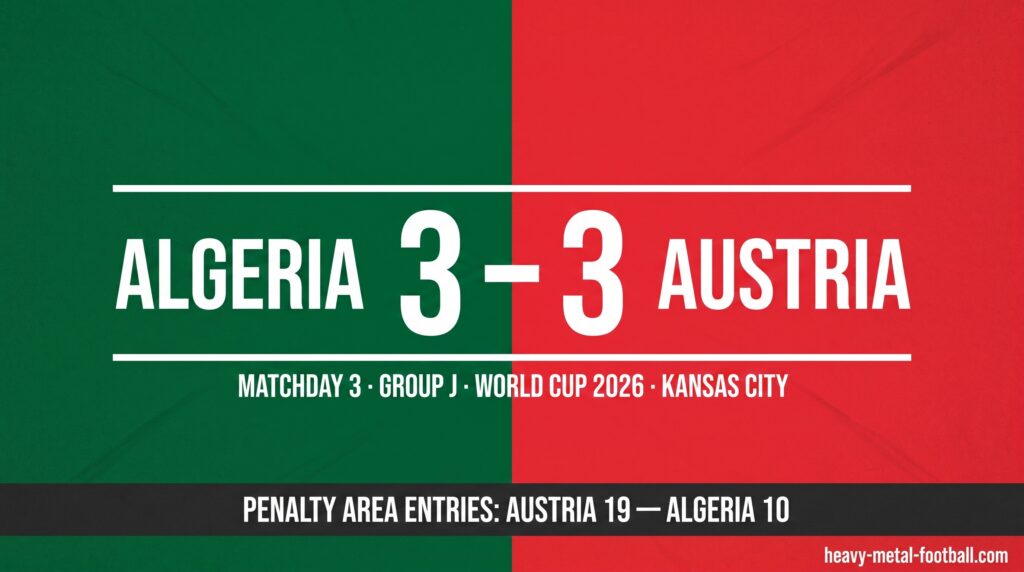
They scored six goals. Algeria’s best player put his team ahead in the 90th minute. Then Kalajdzic walked on and undid it.
The remake became something else entirely.
Algeria Austria Tactical Analysis | Sixty-two and zero
Algeria’s control of this game looks extraordinary on paper. Sixty-five percent possession. Seven hundred and fifty-four completed passes. Sixty-two entries into the Austrian final third. Riyad Mahrez earning top match ratings.
Here is the number that cuts through all of it: Algeria recorded ten entries into the Austrian penalty area. Austria, with thirty-five percent of the ball, managed nineteen.
Sit with that. Algeria had the ball everywhere: into the Austrian final third sixty-two times, thirteen successful dribbles against Austria’s four, passes completing at ninety-three percent. The team with barely a third of possession found their way into the box nearly twice as often.
The explanation is in what Algeria were doing with all that ball. Their 4-2-3-1 built carefully through midfield: Mahrez drifting inside from the right, Aouar probing in the half-spaces, Chaïbi finding pockets in the channels. The ball moved at pace and with precision. And all of it stayed in front of Austria’s defensive line.
Austria’s block sat deep and narrow. The back four held a compact shape, tight enough to seal the central channels. When Algeria moved wide to find crossing angles, they ran into Austria’s aerial dominance: seventy-one percent of aerial duels won, zero of Algeria’s five crossing attempts completed. When Algeria tried to go central, the lanes were blocked. Austria’s midfield four dropped to fill the space between the lines. Algeria’s build-up never generated the pass in behind the defensive line. The line sat deep enough to remove that space, and Algeria’s structure didn’t create the overloads at the right moment to force it open.
The corner count tells you everything: zero. Sixty-two entries into the Austrian final third, and not one moment where a clearance clipped a shin and spun out for a corner. That is what it looks like when a team moves the ball well in front of a block without ever forcing it to act desperately.
The quality was there when Algeria did get through. Minute 40: Chaïbi received centrally at the edge of the box, set the ball on his left foot, and struck hard and half-high. It hit the right post. A minute later, Maza found himself inside the five-metre area after a clearance fell short. Schlager came off his line quickly and saved. Two genuine chances in two minutes, both requiring individual skill or a fortunate bounce to create. Neither came from Algeria’s build-up structure overloading Austria’s shape in any systematic way. That is the distinction. The team could hurt you when you made an error. It just could not force the error. That is the Algeria Austria tactical analysis in miniature: quality at the end of the play, not a structure that generated the play.
Algeria Austria Tactical Analysis | Skip the midfield
Austria had a different idea. Simpler. Don’t pass through Algeria’s press. Go over it or around it.
Arnautović picked up a yellow card in the 11th minute for an elbow in midfield. That booking shaped how Austria operated for the rest of the first half: with a yellow on the striker, Rangnick could not risk pressing hard and exposing him to a second challenge. The deep block that Algeria’s precision build-up crashed against all night was partly a tactical choice and partly an enforced one.
Minute 28. David Alaba, back at a major international tournament after the ACL that had cost him so long, played a single long diagonal behind the Algerian defensive line into the half-left channel. Bensebaini raised his arms for offside instead of tracking. Keeper Oussama Benbout stayed on his line. Arnautović reached the ball first, took it out of the air, and lifted it into the far corner. Austria 1-0. The ball had skipped Algeria’s entire midfield press in one pass. No combination play, no progression through the block, just fifty metres of air and a run timed right.
Watch Laimer in the 55th minute and you see the same principle from a different angle. Laimer drove the right channel at pace, reaching the byline before Algeria’s defensive line could shift, then cut the ball back low to the box edge. Sabitzer struck first-time. Benbout got fingertips to it. The ball rolled in to his right anyway. Austria 2-1. No long ball this time: a run that went around the outside of Algeria’s midfield entirely. Different method, same destination: arriving in the box from a direction that Algeria’s block had never engaged.
The 90+6′ goal is the third variation. But to understand it, you need to go back to halftime.
Ralf Rangnick sent off Xaver Schlager, Romano Schmid, and Arnautović at the break. Florian Grillitsch, Paul Wanner, and Michael Gregoritsch came on. Three simultaneous changes is unusual for any manager. For Rangnick, whose press-heavy systems reward positional continuity, it is close to an emergency signal. The first-half plan had failed in ways the scoreline didn’t fully show: Austria had ceded sixty-five percent of the ball, had one shot on target, and had been kept alive largely by goalkeeper Schlager’s quick feet in the 44th minute. David Alaba came off at 62′ too, his job done: the long diagonal assist logged, ninety minutes of risk not worth taking on a player coming back from a serious injury.
What Gregoritsch’s arrival changed specifically was Austria’s aerial bypass. Arnautović’s game is link-up play: back to goal, holding, bringing runners off him. That profile generated the 28th-minute long ball. It did not create a threat from crosses or set pieces. Gregoritsch’s game is far-post runs and physicality in the box. Austria’s back line suddenly meant something on dead balls in a way it hadn’t in the first forty-five minutes.
The 68th minute showed it first. Sabitzer delivered a corner from the left. Kevin Danso, the defensive substitute who had come on for Alaba, made a late, surging run to the back post, arriving unmarked and at pace. He met the ball cleanly, the goal in front of him, and headed it a few metres wide. Commentary called it a “golden chance.” He was free. The delivery reached him. The header went wide.
The miss mattered. Twenty-two minutes later, the same mechanism arrived again. Sabitzer crossed from the left, Gregoritsch headed across goal from the byline, Kalajdzic attacked from five metres and headed in. One touch. One header. Three-three. Austria had attempted the aerial bypass at 68′. It took until the 90+6′ to land.
Algeria Austria Tactical Analysis | The Aouar-Mahrez relay
Algeria had their own answer. It was narrower than Austria’s three-method approach, but it was real, and it produced three goals.
The principle: Houssem Aouar driving vertically into space, deep and wide on the left, past Austria’s defensive shape rather than into it. When Aouar reached the byline or the space just behind the Austrian line, the square or through-ball arrived from a position that Algeria’s central build-up had never been able to reach. It solved the geometric problem by going around the block rather than through it. The same logic as Austria’s bypass, just from the opposite flank and on far fewer touches of the ball.
Mahrez was the finish point every time. The 45+1′ equaliser began in chaos: Phillipp Mwene tried to let the ball run out near the corner flag, it hit the flag-post and rebounded into play, Mahrez collected, Mwene fouled him, and Belghali finished into the near corner. Chaos triggered it, but Mahrez reading the rebound was not chaos.
The 60th-minute goal was the relay in its cleanest form. Aouar drove the left flank from deep, committed Austria’s right-side defenders to track his run, reached the byline, and squared. The ball rolled to Mahrez, unmarked at five metres. Left foot, into the net. Two-two. The Austrian block that had absorbed sixty-two final-third entries without conceding a corner had been beaten by a single wide run that went behind it rather than against it. The 90+3′ was the through-ball version: Chaïbi drove forward and found Aouar in behind the line, Aouar slipped it sideways to Mahrez in the area, Mahrez finished low into the far corner. Three-two.
The relay worked every time it activated. The problem is that it needed activation. Algeria’s possession game moved in front of Austria’s block for sixty-two final-third entries and reached the box ten times. The relay required Aouar to make a vertical run that Algeria’s patient build-up didn’t structurally generate: it needed a chaos moment, a byline drive, or a through-ball to unlock the wide space that Austria’s narrow block had left open. Austria had three methods for reaching the box. Algeria had one. Both teams scored three times. The difference is why Austria needed Kalajdzic on for ninety seconds to equalise, and why Algeria will spend the flight east thinking about Danso’s header.
Algeria Austria Tactical Analysis | Ninety seconds
In any reasonable version of football, Algeria 3-2 in the 90th minute is the final score. The Disgrace of Gijon’s ghost, already disproven by the previous ninety minutes of six-goal football, could rest.
Rangnick made his last substitution on 90+5′. Phillipp Mwene, whose corner-flag blunder had gifted Algeria their first goal, came off. Sasa Kalajdzic came on.
Ninety seconds later, the aerial bypass landed for the second time.
There is a version of this story about what it means that the 1982 scenario ended in chaos instead of collusion. That version is true. Nobody played for the draw; nobody stood still; nobody decided that the result on the scoreboard was good enough. Six goals is the answer to forty-four years of debate about structural incentives and competitive intent.
But the version Algeria’s players will replay on the flight east is simpler. The 68th minute, Danso’s header wide. The 90+6′, Kalajdzic on for ninety seconds.
Riyad Mahrez was thirty-three years old in Kansas City. He scored twice, activated the relay three times, and should have finished on the winning side. Algeria face Switzerland in the round of thirty-two on Friday, a knockout game on a stage Mahrez may not get back to. There is still a tournament to win. There is still time.
He got ninety seconds instead of the ending he deserved in Kansas City. He gets another chance to write one.
Data & Statistics
Find all the detailed stats here.